Frequently Asked Questions
All puppies are sold with a strict spay/neuter contract. All puppies MUST be spayed/neutered by the age of 10 months. This eliminates the female cycle and testosterone-related behavior associated with male dogs, such as leg lifting to mark territory. Females and males are equally amazing companions! We have both genders as our family pets. They all get along very well.
Currently there are 3 size ranges of the breeds, defined by measuring from the ground to the wither, the highest point on the dog’s shoulder blades.
Miniature/”Mini”: 14″ to 16″ to the shoulder and weigh between 15-25lbs.
Medium: 17″ to 21″ to the shoulder and weigh between 30-45lbs.
Standard: over 22-27″ to the shoulder and weigh 50-80 lbs.
– Australian Labradoodle coats: Fleece (Wavy or Curly) and Wool. These are non-shedding and allergy-friendly.
– F1B coats: Fleece, Curly, Wavy, Wool, Borderline Wavy, and Hair. These can either be shedding or non-shedding.
– F1 coats: Wavy, Borderline Wavy, and Straight. All these coat types vary in shedding from moderate to heavy shedding.
According to the ALAA website:
– Extremely clever, sociable, comical and joyful. Energetic when free and quiet when handled. Should approach people in a happy, friendly manner. Keen and easy to train.
– Should display an intuition about family members or handler’s current emotional state or needs. This ability to “know” is what has made the Australian Labradoodle an excellent dog for individuals with special needs.
– Australian Labradoodles are an extremely intelligent breed of dog. They are sociable, friendly, loving, affectionate, confident, loyal, and devoted. They crave stimulation, interaction, and companionship. Australian Labradoodles are not aggressive. They are wonderful around everyone from children to the elderly. Labradoodles are not only companions but also therapy, guide, and emotional support dogs. They love to comfort you when you are sad or sick. They love hard!
YES!!!!!! This is also why there is such a huge price difference as well! A Labradoodle is a simple Labrador and Poodle cross. This is also referred to as an American Labradoodle.
The Australian Labradoodle breed dates back to the 1980’s and was initiated with the intent to create a breed that had the temperament of a service dog and was allergy and asthma friendly. During the 1990’s breeders in Australia began breeding Labradoodles to a number of other dog breeds in an effort to produce litters with consistent conformation, coat type, and temperament. Most often the English Cocker Spaniel and American Cocker Spaniel were the breeds used, however, it is reported that a few other dog breeds were also introduced into certain lines. DNA evidence of these dog breeds are still found in a few lines today, while others were bred out and not re-introduced into any other blood lines.
Currently the Australian Labradoodle is considered to be a cross between the Poodle, Cocker Spaniel and Labrador Retriever, while the Labradoodle is a cross between the Labrador Retriever and Poodle. This distinction of the breeds and the ALAA’s commitment to the breeds’ health was formally recognized with the creation of the separate breed code Australian Labradoodle by the OFA (the Orthopedic Foundation for Animals). (directly from ALAA website)
Types of Labradoodles:
F1: The “F” stands for “filial generation”. “F1” means “the first generation” and is a common scientific term. This, in the Labradoodle breed, is the coding for a first-cross, purebred poodle to purebred Labrador Retriever. The results are mixed, as this is not the breeding of two “like” dogs, or dogs that resemble each other. F1 Labradoodles typically are moderate-shedding and have a sparse-hair to fleece coat.
F1B: The additional “B” refers to backcross — an F1 Labradoodle, as defined above, bred (or backcrossed) to a purebred Poodle. Again, the results are mixed, as this is not the breeding of two “like” dogs. F1B Labradoodles typically are low- to non-shedding (or as much as any dog can be non-shedding) and often have a hair or fleece coat.
Australian Labradoodle: The Australian Labradoodle carries the DNA of the Labrador, Poodle, Irish Water Spaniel, Curly Coat Retriever, American Cocker Spaniel, and English Cocker Spaniel. The resulting offspring share characteristics, though some pairings of parent dogs will produce a more mixed litter. An Australian Labradoodle can be created by crossing a Poodle to another Australian Labradoodle, a Cockapoo to a Labradoodle, a Labradoodle to a Cocker Spaniel, and the like, resulting in the three-breed combination. Australian Labradoodles typically have a non-shedding coat (again, as much as any dog can be non-shedding) if both parents are non-shedding.
Multigen Australian Labradoodle (Multigenerational): A Multigenerational (Multigen) Australian Labradoodle comes about from the breeding of one Australian Labradoodle to another. Multigen Australian Labradoodles typically have a non-shedding coat (as much as a dog can be non-shedding) if both parents are also non-shedding. Generally in these days we are talking about a Labrador, Poodle & Cocker Spaniel mix.
Purebred Australian Labradoodle: The Merriam-Webster Dictionary first defined “purebred” in 1852 as “bred from members of a recognized breed, strain, or kind without a mixture of other blood over many generations.” The AKC, meanwhile, requires four generations of like-to-like matings in their foundation service. The ALAA uses these two references in its definition of a Purebred Australian Labradoodle. Once an Australian Labradoodle has been bred to another Australian Labradoodle in four consecutive matings, it will be considered purebred.
Information obtained from the ALAA website.
ALD Colors & Patterns
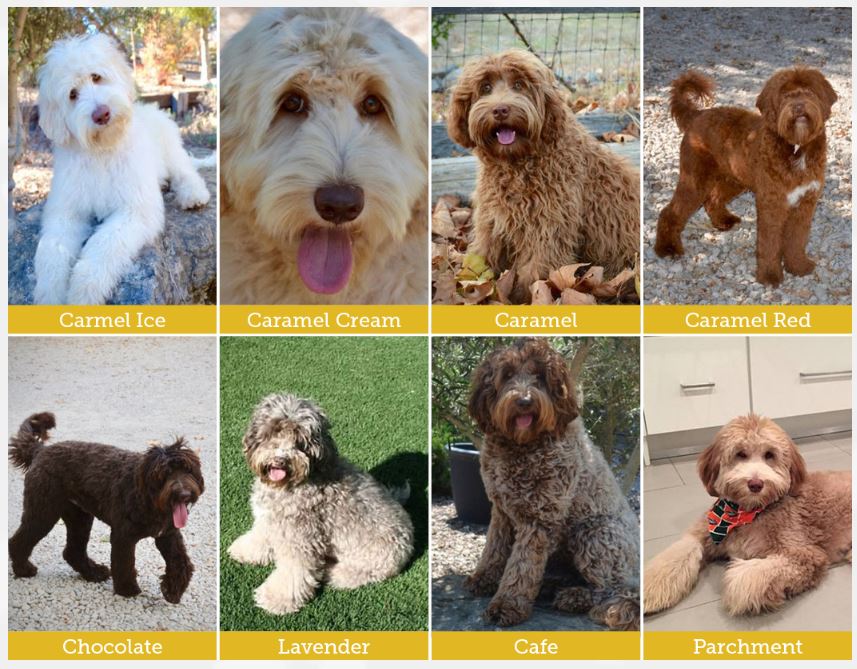
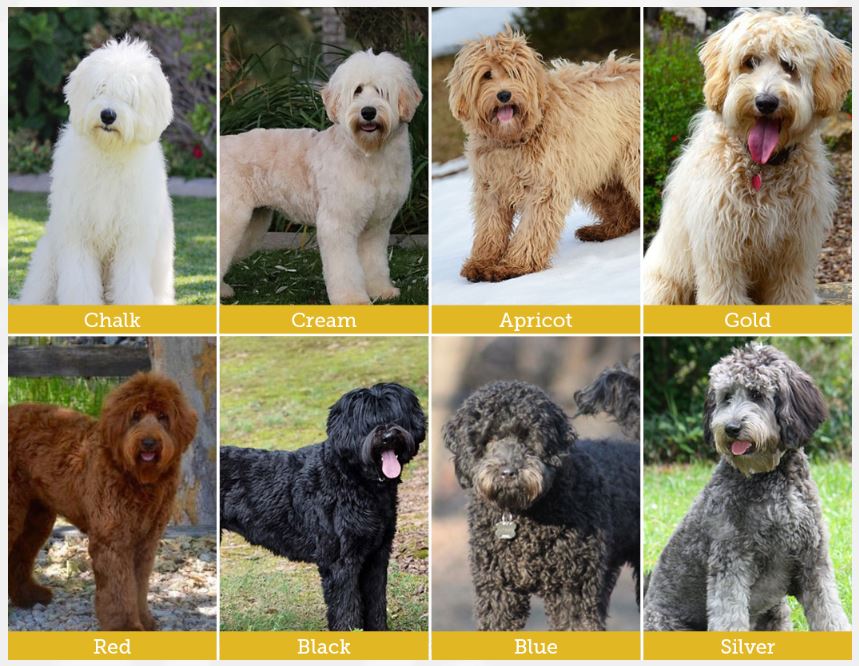
ALD’s have a wide variety of possible colors. We have not been around long enough to produce all of the colors. So for the sake of learning, I am referencing you back to the ALAA Website for colors. I will add their chart below as well. We have learned that many of our customers are divided as to their favorites. We have customers that insist on black nose only and vice versa.
Black Pigmented
Black pigmented dogs – (black nose) can produce the following colors:
- Chalk
- Cream
- Apricot
- Gold
- Red
- Black
- Blue
- Silver
Brown Pigmented
Brown pigmented dogs – (brown or liver nose) can produce the following colors:
- Caramel Ice
- Caramel Cream
- Caramel
- Caramel Red
- Chocolate
- Lavender
- Café
- Parchment
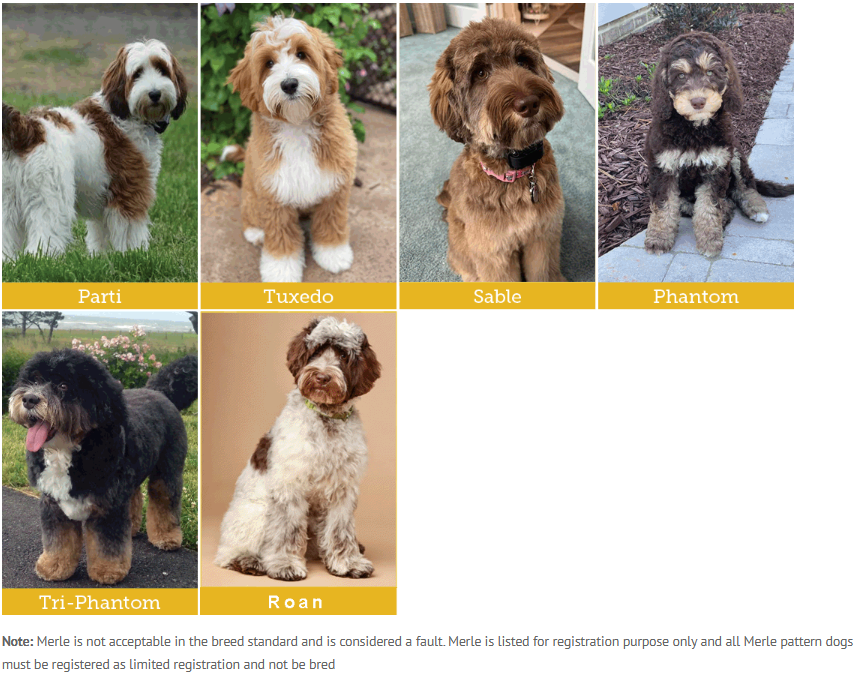
Patterns
- Solid/Abstract – Solid is what it is & Abstract means some white mismarks
- Parti – At least 50% of the body is white)
- Tuxedo – White on head, face & white chest that wraps around the neck to the back.
- Sable-Varies
- Phantom – Typically brown on legs and points on the face
- Tri-phantom – Same as above but with a 3rd color white.
- Roan -Roan causes pigmented hairs to grow in all areas with white spotting. This mixture of pigmented and unpigmented hairs without the formation of distinct spots often gives a more evenly grizzled look compared to ticking. But roaning can also be patchy and look similar to very dense ticking[2].